
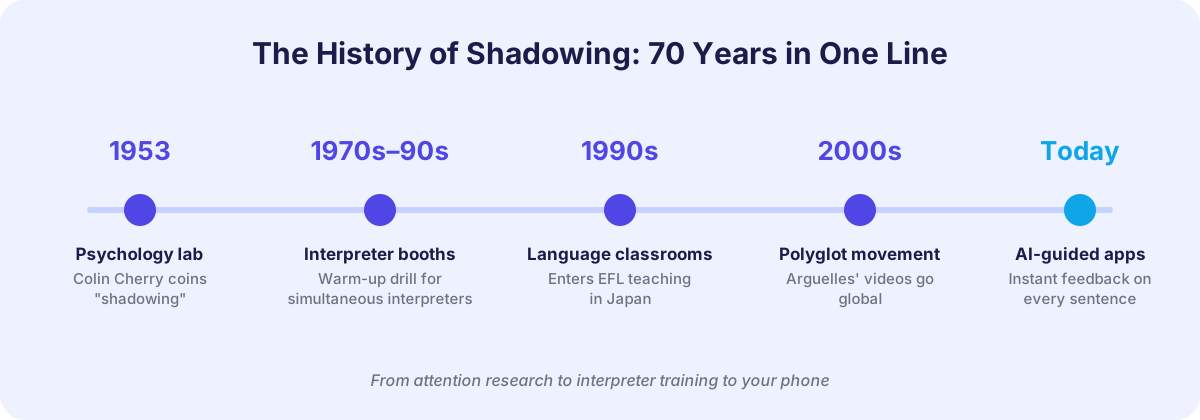
Shadowing feels like a modern hack — the kind of technique you stumble on in a YouTube comment section and wonder why nobody taught you sooner. But the history of shadowing goes back over 70 years, and it didn't start in a language classroom at all. It started in a psychology lab, moved into interpreter booths at international conferences, and only reached everyday language learners in the last few decades. Knowing where the technique came from makes it easier to trust why it works — and if you're not yet sure what the method actually involves, start with our guide to what shadowing is and how it works.
Here are the three moments that turned "repeat what you hear, immediately, out loud" from a lab procedure into one of the most effective speaking drills available to language learners today.
1. 1953 — A psychologist names the technique while studying attention, not language
The word "shadowing" didn't originate with language teachers. It came from British physicist and psychologist Colin Cherry, who was trying to understand how people manage to follow one conversation at a crowded party while dozens of others compete for their attention — what's now called the cocktail party effect.
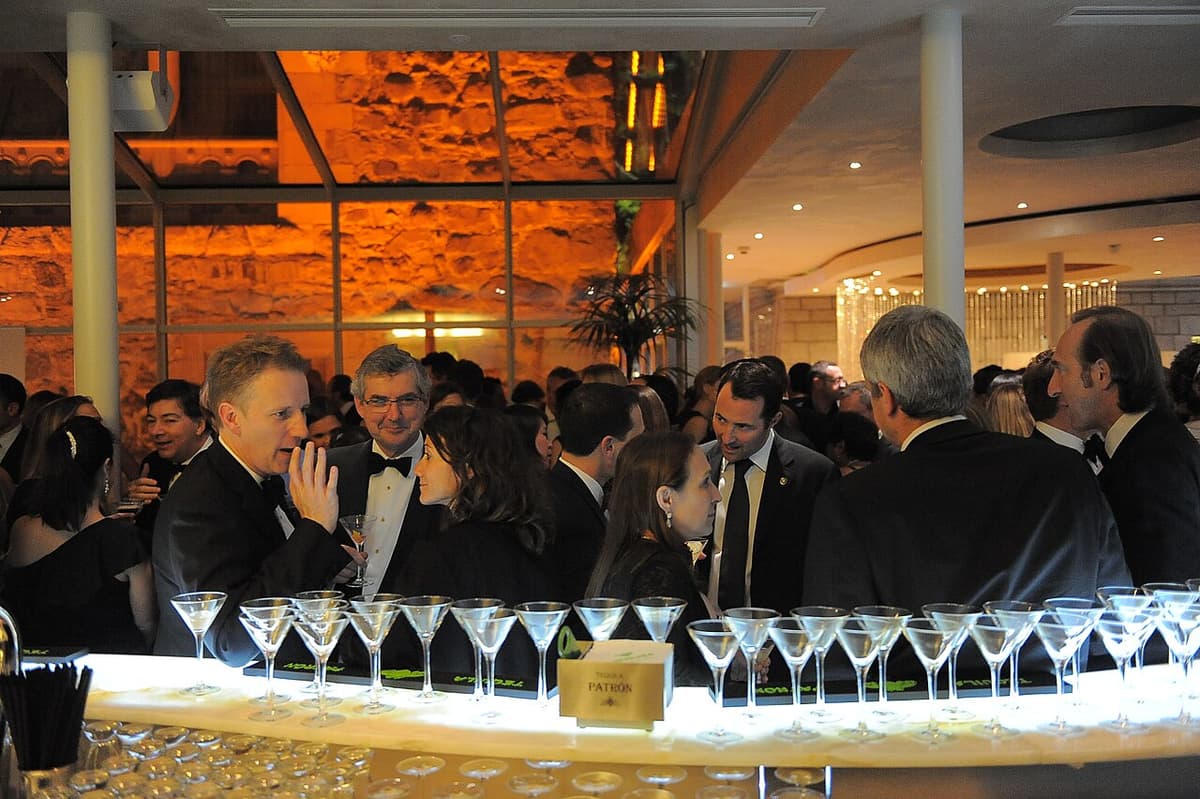
To study this, Cherry designed an experiment: play two different audio messages, one in each ear, and ask the listener to repeat aloud — to "shadow" — only the message in one ear while ignoring the other. He found that people could track physical qualities of the ignored message (a change in pitch, a switch from a male to a female voice) but almost nothing about its content — even a switch from English to German in the unattended ear usually went unnoticed. Later psychologists, including Anne Treisman and Donald Broadbent, refined the shadowing procedure into one of the central tools of attention research, using it to build competing theories of how the brain filters incoming sound.
None of this was designed as a language-learning method. But it proved something crucial that shadowing still relies on: repeating speech in real time forces the brain into a state of intense, involuntary focus. You cannot half-listen and shadow at the same time — the task demands full attention to sound, rhythm, and timing, which is exactly the state you want to be in when training your ear and mouth for a new language.
2. The 1970s–90s — Interpreter trainers adopt it as a warm-up drill
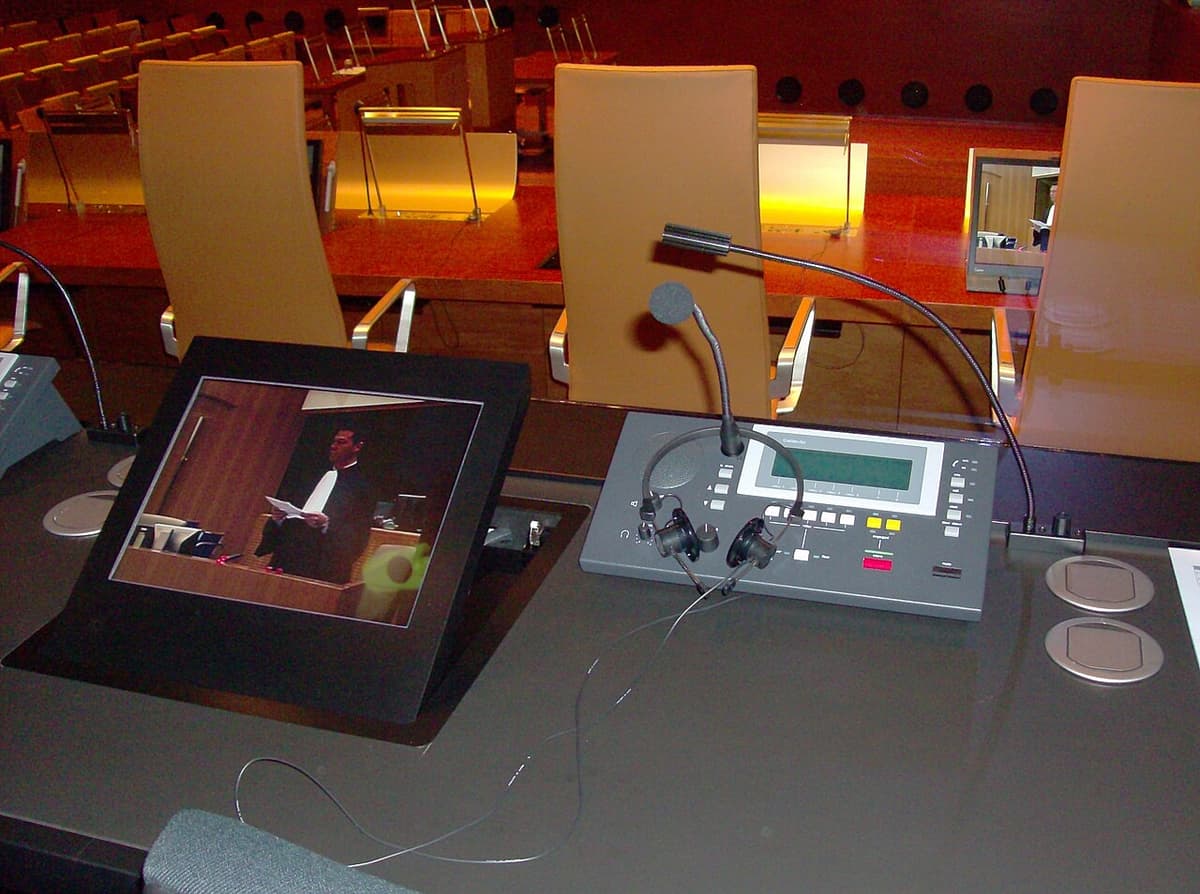
Decades after Cherry's experiments, a very different group discovered shadowing independently: conference interpreter trainers. Simultaneous interpreters have to listen and speak in two different languages at almost the same moment, so trainers were looking for exercises that built the underlying skill — tracking incoming speech while producing outgoing speech without falling behind.
Shadowing (sometimes called "parrot-style tracking") became a common early-stage exercise: trainees would listen to a recording and repeat it word-for-word in the same language, as closely in sync as possible, before ever attempting to interpret between two languages. Sylvie Lambert's research in the early 1990s was influential in formalizing shadowing as a legitimate stepping stone in interpreter training, even though — and this is worth knowing — the exercise has always been somewhat controversial among interpreting educators, since shadowing alone doesn't require understanding or analyzing the message, only reproducing it.
That controversy is actually useful context for language learners. Shadowing was never meant to replace comprehension work, vocabulary study, or grammar — interpreter trainers used it specifically to build automatic, low-level speech production skills (timing, rhythm, articulation) that free up mental bandwidth for the harder cognitive work layered on top. That's precisely the role it should play in your own routine: a fluency and pronunciation drill, not your only source of input.
It's also worth noting what made shadowing attractive to interpreter trainers in the first place: it's one of the only exercises that forces a learner to produce speech in real time, at the speaker's pace, without the safety net of pausing to think. Reading and listening comprehension can happen at your own speed; shadowing cannot. That constraint is uncomfortable, which is exactly why it works — it's the same discomfort you feel the first few times you try to speak spontaneously in a real conversation, except here you can practice it alone, with a recording, as many times as you need.
3. 1990s–2010s — Shadowing crosses over into everyday language learning
Shadowing stayed a specialist's tool for interpreters and cognitive scientists until the 1990s, when it began appearing in English-as-a-foreign-language teaching, notably in Japan, as a listening and pronunciation exercise for general learners rather than interpreter trainees. This was the first real bridge between the lab/interpreter-booth version of shadowing and something an individual learner could do alone with a recording.
The technique reached a much wider, global audience thanks to Alexander Arguelles, a polyglot and linguist who spent years publicly demonstrating and refining his own shadowing method — often filmed walking briskly outdoors while repeating foreign-language audio aloud, headphones on, book in hand. Arguelles argued that physical movement heightens attention and helps "embed" the language motorically, not just mentally. His videos, published from the mid-2000s onward, turned shadowing from an obscure interpreter-training exercise into a technique any self-directed learner could try with nothing more than a phone and a pair of earbuds.
That clip is Arguelles himself discussing the method — worth watching once before you try it yourself, since seeing the pacing and intensity of real shadowing makes it much easier to imitate than reading a description of it.
If you want to go deeper, these are the original resources where Arguelles demonstrates and explains his method:
 Shadowing Step by StepArguelles' own walkthrough of the full technique — pacing, posture, and how to progress. The definitive tutorial.
 Shadowing a Foreign Language (Chinese)The famous live demonstration: Arguelles shadowing Chinese at full walking pace, exactly as he recommends practicing.
How to Practice Shadowing Today
You don't need a psychology lab or an interpreter's headset — just audio you can replay and a few minutes of focus.
- Pick short, clear audio. A 30–90 second clip of a native speaker talking at a natural pace — a podcast excerpt, an interview, a scene from a show — works better than a full-length video for your first attempts. Here are two ready-to-use clips with short, simple everyday phrases — play each and repeat right after the speaker:
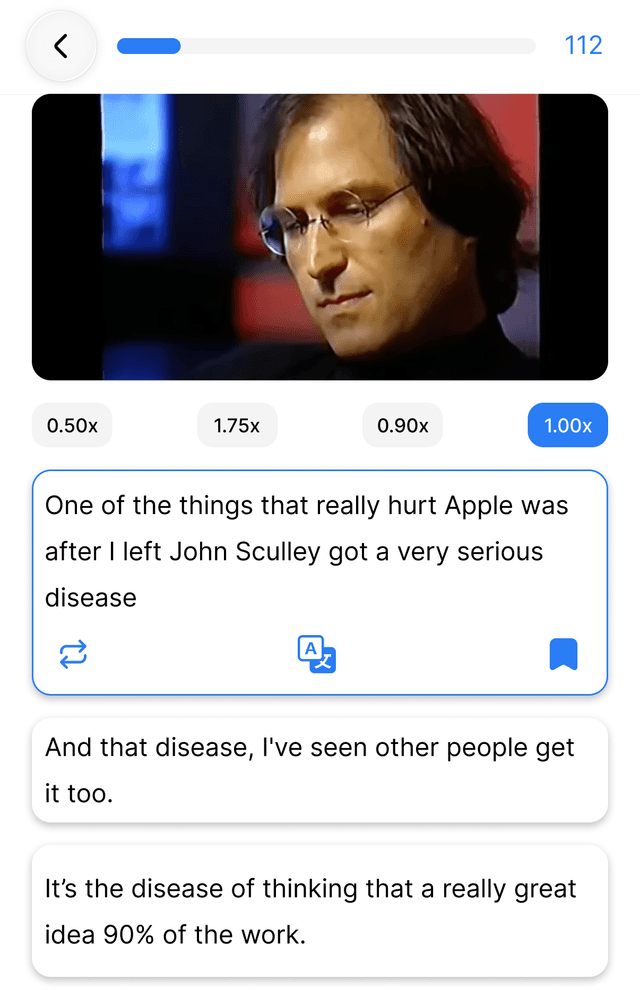
- Listen once, without speaking. Get a general sense of the content, rhythm, and speaker's tone before you try to reproduce anything. In the Speak Pro app you can listen sentence by sentence — each segment is a card you can replay at 0.5x–1.75x speed until the rhythm sticks:
-
Play it again and shadow immediately. Speak at the same time as the recording, staying as close behind the speaker as you can — not translating, not thinking ahead, just tracking sound with your mouth.
-
Record yourself and compare. This is the step most learners skip, and it's the one that actually drives improvement. Listen back for gaps in timing, flattened intonation, and sounds you're smoothing over. Speak Pro does this comparison for you — record a sentence and it highlights, word by word, where your pronunciation matched the original and where it slipped:

- Repeat the same clip 3–5 times before moving on. Shadowing rewards repetition; a clip you can barely keep up with on attempt one should feel almost automatic by attempt five.
A common mistake is choosing audio that's too fast or too information-dense for a first attempt — remember that even trained interpreters started with simple, single-language repetition before layering on any translation. If you're constantly losing the thread, drop to a slower clip or a shorter segment rather than pushing through; shadowing only builds the reflex you're after when you can mostly keep pace with the speaker.
Why This Works Better Than Textbook Study
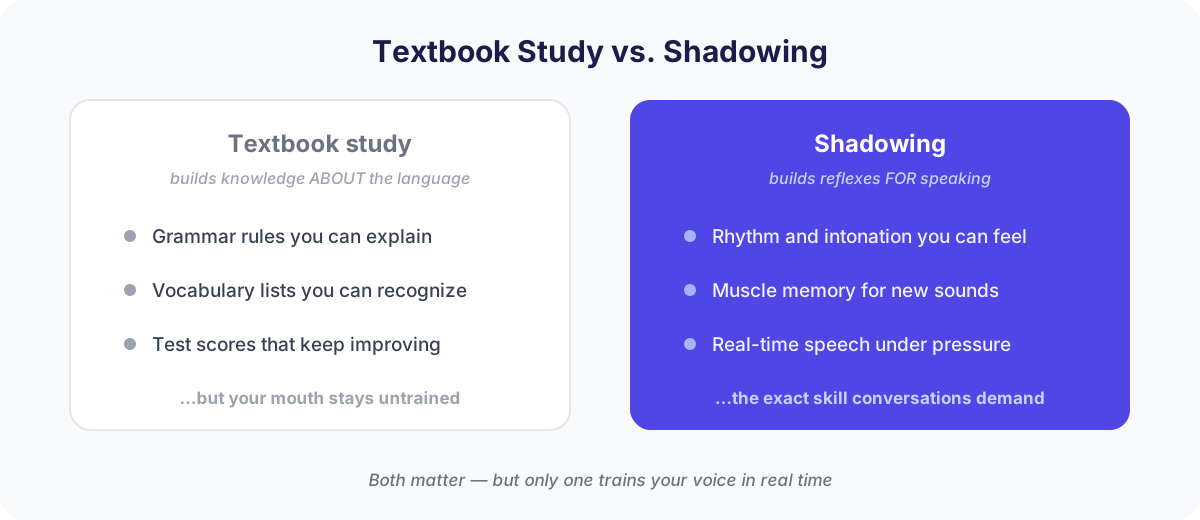
Grammar drills and vocabulary lists build knowledge about a language. Shadowing builds the physical and cognitive reflexes of using it — matching rhythm, timing your breath to sentence structure, producing sounds your mouth has never had to make before. That's exactly the gap Cherry's dichotic listening subjects and today's interpreter trainees both had to close: the ability to process and produce speech simultaneously, under time pressure, without falling behind.
It's also why shadowing feels harder than it looks the first few times you try it. You're not just learning words — you're training a genuinely new motor and attentional skill, the same one researchers have been studying since 1953. And it's precisely the skill most learners are missing when they understand a language well but still can't speak it — a gap we break down in why you still can't speak fluently.
Common Questions About the History of Shadowing
Who invented the shadowing technique?
No single person "invented" it. Psychologist Colin Cherry coined the term in 1953 as a laboratory procedure for studying attention. Interpreter trainers later adopted it as a speaking drill, and polyglot Alexander Arguelles popularized it for language learners in the 2000s through his public demonstrations and videos.
When did shadowing become popular for language learning?
Shadowing stayed a specialist tool for psychologists and interpreters until the 1990s, when it entered foreign-language teaching in Japan as a listening and pronunciation exercise. Global popularity came in the mid-2000s, when Alexander Arguelles began publishing videos of his walking-and-shadowing method, and grew further as apps made the technique easy to practice on a phone.
Is shadowing backed by research?
Yes — in two separate fields. Attention researchers have used shadowing experimentally since Cherry's 1953 dichotic listening studies, and interpreting researchers such as Sylvie Lambert studied it as a training exercise in the 1990s. Studies in language education since then have linked regular shadowing practice to measurable gains in listening, pronunciation, and speech rate.
Practice With Real Audio, Not Just Theory
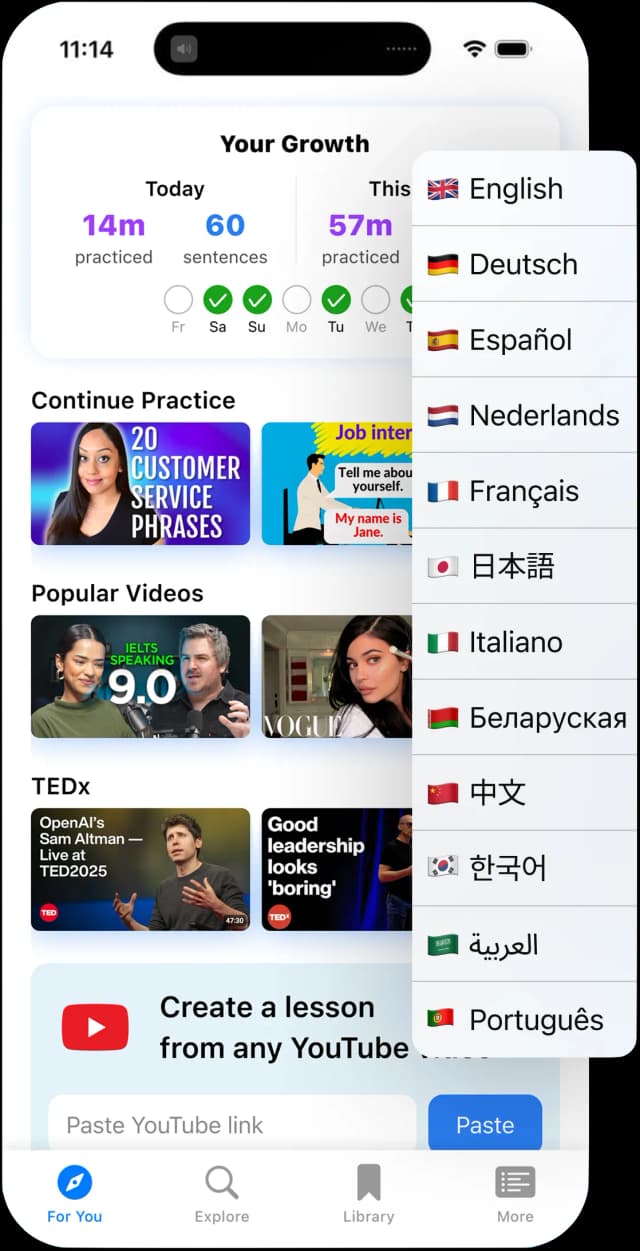
Reading about shadowing's history is a five-minute exercise. Actually doing it — with real native-speaker audio, immediate feedback on your pronunciation, and a clip you can replay as many times as you need — is what builds the skill. Speak Pro turns any YouTube video into a structured shadowing session, segment by segment, with AI feedback comparing your recording to the original. If you've been meaning to try the technique Arguelles made famous, this is the fastest way to start today.
Ready to finally speak instead of just study?
Turn any YouTube video into a guided shadowing session with instant AI feedback. Daily speaking practice becomes effortless.