
Most language learners can list the shadowing steps (listen, repeat, record, compare) long before they can tell you what it gets them. That gap matters, because the case for the shadowing benefits isn't abstract. It shows up as three specific, noticeable changes: you start catching words at natural speed instead of straining for them, your mouth starts producing sounds it used to fumble, and sentences start leaving your mouth without a translation delay in the middle. If you already know the mechanics and want the science behind why it works, read the science of shadowing first. This article stays on the ground: what changes, in what order, and how to notice it happening to you.
Here are the three benefits of shadowing that learners report first, why each one happens, and a practical way to start collecting all three this week.
1. Sharper listening comprehension: best for understanding native speakers at full speed
The first benefit of shadowing in language learning almost never shows up in your own speech. It shows up in your ears. Shadowing forces you to track incoming audio in real time, with no pause button and no rewind, which is a completely different skill from reading a transcript or replaying a line five times. Your brain has to segment a fast stream of sound into words while your mouth is already reproducing the previous ones, and that dual demand is exactly what ordinary passive listening never asks of you.
Researchers who study speech shadowing as a listening task have found that learners who train this way improve word recognition and phoneme perception first (the raw ability to hear where one sound ends and the next begins) before broader comprehension catches up. That order matters practically: don't expect to understand a fast podcast top to bottom after a week of shadowing. Expect, instead, that a sentence you previously heard as a blur starts resolving into individual words, and that the resolving happens faster each week.
This is also why shadowing beats subtitle-reading as a listening exercise. Reading along lets your eyes do the segmenting your ears should be doing. Shadowing removes that crutch. You can't read and repeat in real time, so your ear has to do the work, which is precisely the muscle most learners never train.
2. Clearer pronunciation: best for sounding more natural and confident
The second benefit of shadowing is the one people notice fastest in other people: pronunciation that sounds less effortful and more native-like, even without a flawless accent. This happens because shadowing forces your mouth to attempt sounds, stress patterns, and intonation contours at full native speed, immediately after hearing them, not after a pause to think about how to form them. That immediacy is the entire mechanism. A systematic review of shadowing research on pronunciation training found consistent gains in learners' comprehensibility and speaking fluency when shadowing was practiced regularly, even over a matter of weeks.

Note what improves fastest here: rhythm, stress, and intonation (the melody of speech) tend to shift before individual sounds do. If you've struggled for months with one specific phoneme (a rolled R, a th-sound, a vowel your native language doesn't have), shadowing helps, but it isn't magic for that one sound overnight. Where it helps immediately is the bigger, more noticeable stuff: whether your sentences rise and fall the way a native speaker's do, whether your stressed syllables stand out, and whether your speech has the connected, run-together quality of natural conversation instead of a string of carefully separated words. That's most of what listeners register as "accent," long before they consciously notice individual sounds.
3. Faster, more automatic speech: best for cutting hesitation and filler words
The third of the shadowing technique's language learning benefits for speaking is the one that changes how conversations feel: speed and automaticity. This is a distinct skill from vocabulary size or grammar accuracy. You can know every word in a sentence and still freeze producing it, because retrieving and sequencing words in real time under social pressure is its own trained ability. Shadowing trains exactly that, because it forces continuous output at a pace you don't control, over and over, until your mouth stops waiting for permission from your brain.
The gain isn't more words — it's fewer gaps between them.
A study examining shadowing's effects on the brain's language-processing systems found measurable changes in working memory and neural efficiency after just a few weeks of regular shadowing practice, specifically in the circuitry responsible for holding and rehearsing speech in real time. That's a fairly literal description of what "automaticity" is: your brain needs less conscious effort to hold a sentence together while producing it, which is exactly why fluent speakers don't seem to be translating in their heads. They aren't, and shadowing is one of the few drills that trains that specific gap closed.
Learners who shadow regularly consistently describe the same shift: fewer "um"s and restarts, less of the pause-while-I-find-the-word feeling, and a sense that their mouth is keeping up with their thoughts instead of lagging a full beat behind. None of that requires new vocabulary. It requires practicing the retrieval and production loop at speed, which is precisely what passive study never asks you to do.
How to start shadowing English today
You don't need special equipment to start collecting these three benefits, just short audio you can replay and a few minutes of focused attention.
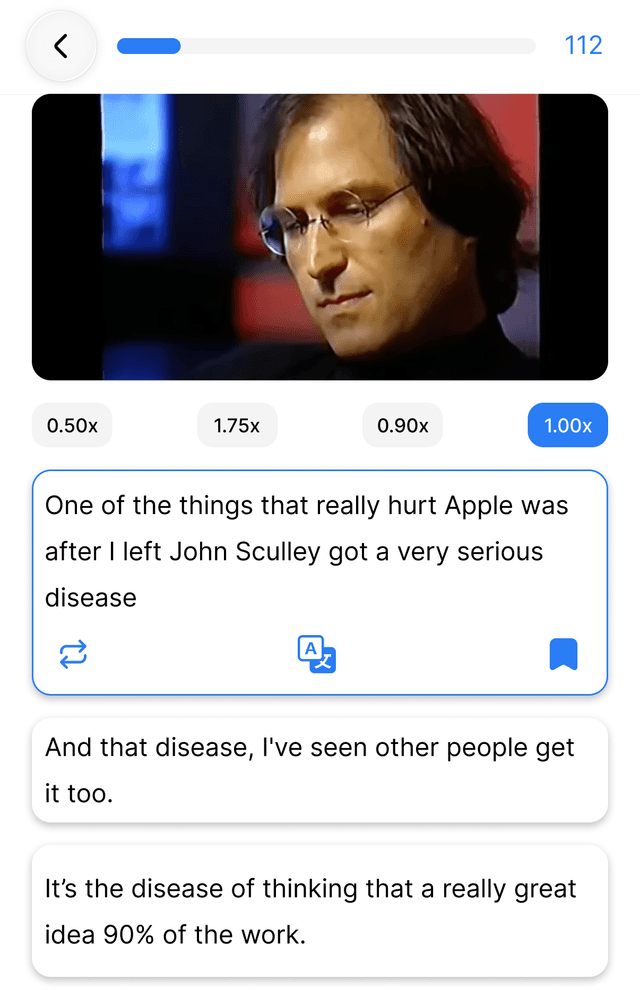
- Pick one 30–90 second clip at a pace you can mostly follow. Material that's slightly above comfortable (not word-for-word familiar, not incomprehensible) trains listening comprehension fastest. Here are two ready-to-use clips with short, clear material to shadow. Press play and repeat right after the speaker:
-
Listen once through, without speaking. Let your ear register the rhythm and the general shape of the sentences before you try to reproduce anything. This first pass is where the listening-comprehension benefit starts.
-
Play it again and shadow immediately, staying as close behind the speaker as you can. Don't stop to translate or think ahead; the point is to keep your mouth moving in real time, even if you drop a word here and there.
-
Record yourself and compare. This step is where the pronunciation benefit gets locked in. You can't fix what you can't hear, and most learners badly overestimate how close their recording sounds to the original until they play the two back to back.
-
Repeat the same clip 3–5 times before moving to a new one. Each pass should feel a little more automatic than the last; that decreasing effort, session over session, is the fluency benefit becoming measurable.
A common mistake is switching clips too often, chasing novelty instead of repetition. The benefits of shadowing in language learning compound with repeated passes over the same material: five repetitions of one clip beats one repetition of five clips, every time, for building automaticity.
Why this works better than textbook study
Both matter — but only one trains your voice in real time.
Textbooks and grammar drills are useful: they build vocabulary, rules, and reading comprehension you can explain on demand. But none of the three benefits above live in that kind of knowledge. Listening comprehension at native speed, pronunciation your mouth produces without conscious effort, and speech that comes out without an internal translation delay are all procedural skills, the kind you build by doing the action under time pressure, not by understanding it. You can ace a grammar quiz on a sentence and still stall out trying to say it out loud at conversational speed, because the quiz and the conversation are testing entirely different systems in your brain.
That's the specific gap the shadowing method benefits fill, and it's also why a lot of learners plateau despite years of study: they keep reinforcing the knowledge system while the production system (listening at speed, pronouncing at speed, retrieving at speed) stays untrained. If you recognize that plateau in yourself, why you still can't speak fluently traces the same underlying gap from a different angle.
Common questions about the benefits of shadowing
Three benefits, one daily habit: repeat what you hear, right as you hear it.
What are the benefits of shadowing for language learning?
The three main benefits are sharper listening comprehension, clearer pronunciation (especially rhythm, stress, and intonation), and faster, more automatic speech with fewer hesitations. Shadowing trains all three at once because it forces simultaneous listening and speaking under real-time pressure, which passive study never does.
How does shadowing improve speaking fluency?
Shadowing forces continuous output at a pace you don't control, which trains the word-retrieval and production loop directly. Over repeated sessions, this reduces reliance on mental translation and produces measurable gains in working memory efficiency for real-time speech, which is why fluent shadowers hesitate less and restart sentences less often.
Can shadowing help with pronunciation?
Yes. Shadowing improves pronunciation primarily by training rhythm, stress, and intonation first, with individual sound accuracy improving more gradually. Because you reproduce native speech immediately after hearing it, at full speed, your mouth practices the muscle patterns of natural speech rather than a slowed-down approximation.
Start getting these benefits today
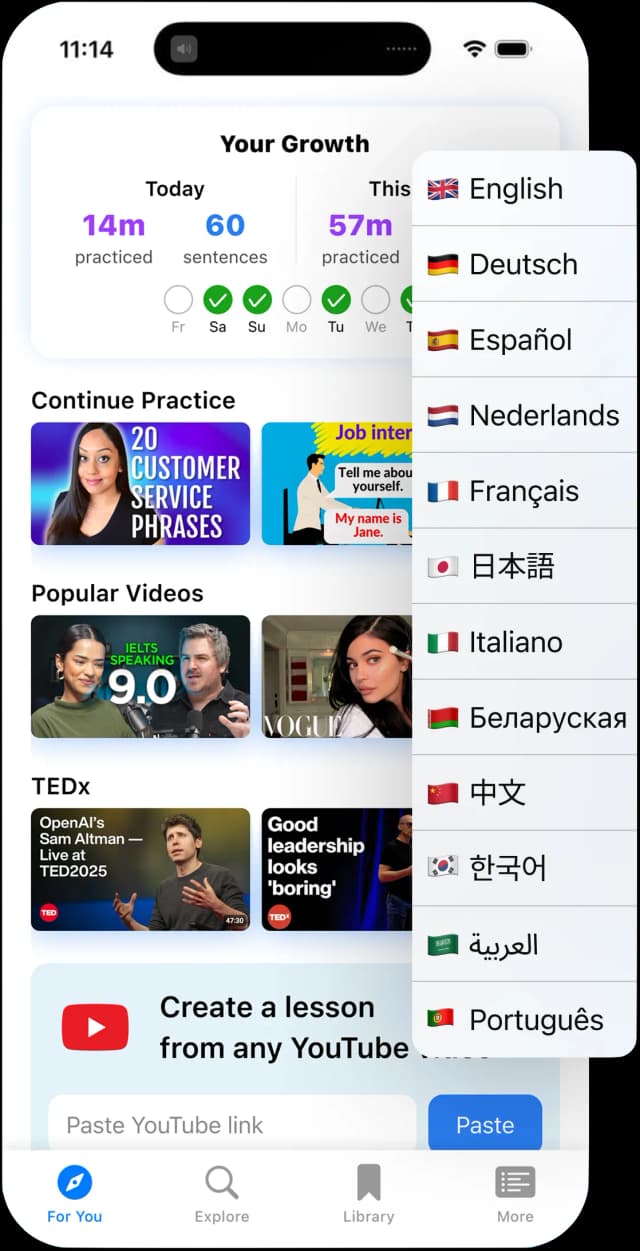
The three benefits of shadowing (sharper listening, clearer pronunciation, and faster, more automatic speech) aren't theoretical. They show up within weeks of consistent short sessions, and they compound the more you repeat the same material rather than constantly chasing new clips. Speak Pro turns any YouTube video into a sentence-by-sentence shadowing lesson, lets you slow the audio down until you can keep pace, and scores your recording against the original so you know exactly what's improving. If you've been meaning to start, the fastest way to feel these benefits is to shadow one short clip today.
If you want the research trail behind these claims, shadowing research walks through the studies in more depth, including the listening comprehension results from a 2025 classroom study that measured the same gains described above in real students.
Ready to finally speak instead of just study?
Turn any YouTube video into a guided shadowing session with instant AI feedback. Daily speaking practice becomes effortless.