
You can pass a grammar test, read a novel, and follow a whole Netflix episode without subtitles — and still freeze the moment someone asks you a simple question out loud. That gap is not a sign you're a bad learner. It's a predictable result of how the brain stores and produces language, and it's exactly the gap the science of shadowing is built to close. Once you understand what's happening in your head when you speak, shadowing stops looking like a party trick and starts looking like the most efficient speaking drill available.
This is the brutal truth most courses won't tell you: studying builds knowledge about a language, but speaking is a physical, real-time skill with its own wiring. Below we'll walk through why comprehension and production live in different systems, where the bottleneck is, the five mechanisms that make shadowing work, and how to turn that science into a daily routine. If you're new to the method itself, start with what shadowing is and how it works.
Why Understanding a Language Isn't the Same as Speaking It
Comprehension and production are not two ends of one skill — they're different jobs handled by different networks. When you listen, your brain only has to recognize patterns: it catches a few anchor words, predicts the rest, and fills gaps from context. It can afford to be lazy because meaning is being handed to it. Producing speech is the opposite. You have to retrieve the words yourself, assemble them in the right order, recall each sound, and move your mouth to make them — all in real time, with someone waiting.
That's why you can understand far more than you can say. Understanding is pattern matching; speaking is pattern building under time pressure. Reading and listening practice make you better at matching. They do almost nothing for building, because building is a motor and memory skill that only improves when you actually produce speech at speed.
The Bottleneck Between Your Ears and Your Mouth
Simplified, language runs through two hubs on the left side of the brain: a comprehension region (traditionally linked to Wernicke's area) that decodes incoming speech, and a production region (traditionally linked to Broca's area) that plans and sequences the words you say. You've spent years feeding the comprehension side and barely touching the production side. The result is a lopsided system: a wide input pipe and a narrow output pipe.
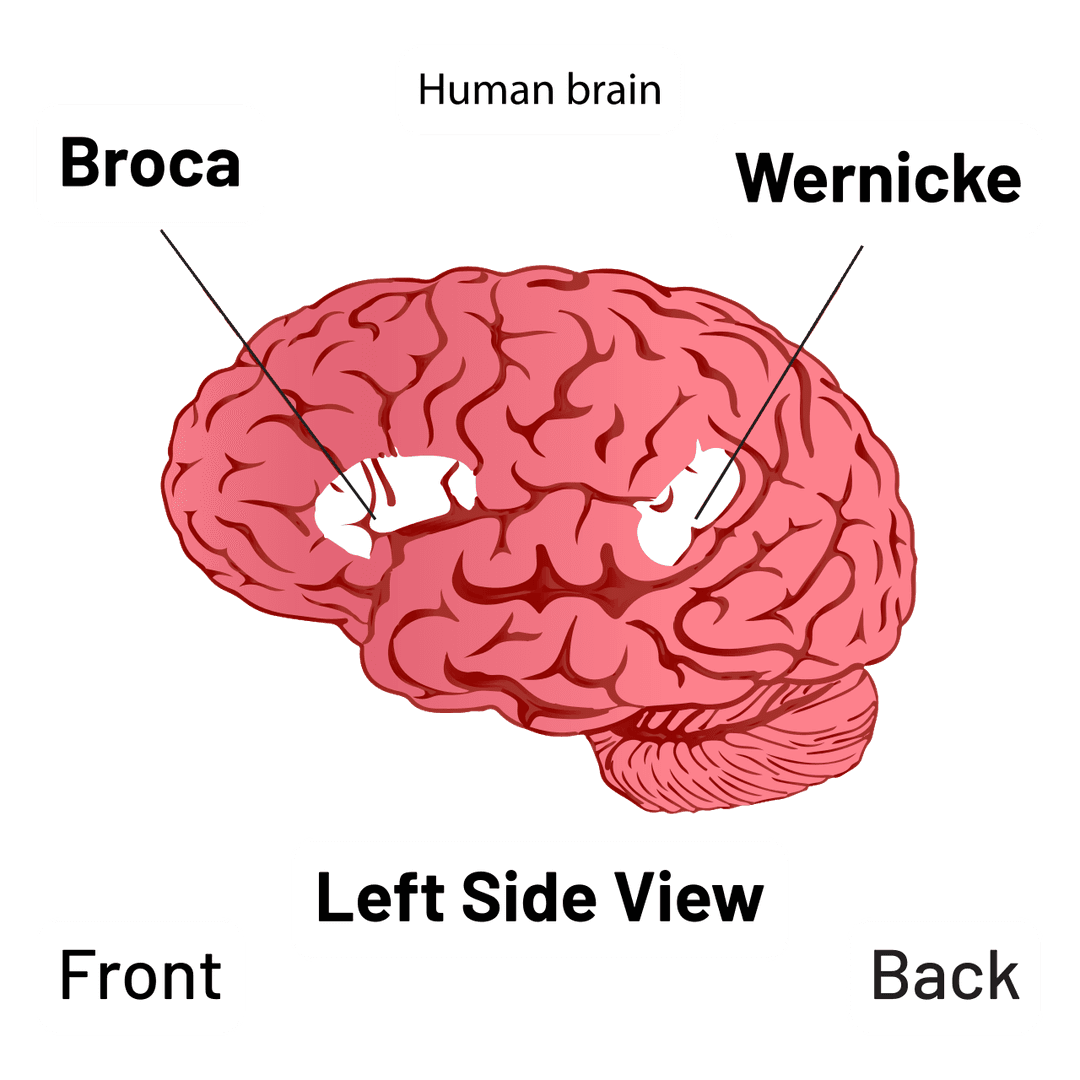
When you try to speak, that output pipe gets overwhelmed: retrieving vocabulary, applying grammar, recalling pronunciation, and coordinating your mouth all compete for the same limited attention at once. Your working memory floods, you lose the thread, and you default to silence. Shadowing attacks this bottleneck directly, because it forces the production side to run at native speed — with the answer already supplied, so retrieval and grammar aren't fighting for space.
5 Reasons Shadowing Works, According to Science
Shadowing — repeating speech out loud in real time, a beat behind a native recording — isn't effective by accident. It happens to hit five mechanisms that language production actually depends on.
| Mechanism | What it does |
|---|---|
| Auditory–motor coupling | Links what you hear directly to what your mouth does — the core speaking reflex. |
| Automaticity (proceduralization) | Moves language from slow, effortful recall to fast, automatic production. |
| A stronger phonological loop | Trains the working-memory loop that holds and rehearses sound in real time. |
| Prosody & prediction | Internalizes rhythm and stress, so your brain anticipates what comes next. |
| Lower cognitive load through chunking | Groups words into ready-made units, freeing mental bandwidth to speak faster. |
1. It couples hearing to speaking
Fluent speech depends on a tight link between the sound you perceive and the movement your mouth makes. Shadowing exercises exactly this auditory–motor loop: you hear a sound and produce it in the same instant, over and over, until the connection becomes reflexive rather than deliberate.
2. It builds automaticity
Early language use is declarative — slow, conscious, effort-heavy recall. Fluency is procedural — fast and automatic, like riding a bike. Repeated real-time production is how the brain proceduralizes a skill, and shadowing is nothing but repeated real-time production.
3. It strengthens the phonological loop
The phonological loop is the part of working memory that briefly holds and silently rehearses sound. It's central to repeating and eventually storing new words. Shadowing hammers this loop directly, which is one reason interpreters — who need to hold speech in mind while producing more — have used it as a training drill for decades (a history covered in our history of shadowing).
4. It internalizes prosody and prediction
Two people can be grammatically perfect and still sound worlds apart, because one has the language's melody — its rhythm, stress, and intonation — and the other doesn't. Shadowing forces you to match that prosody in real time. As a bonus, tracking a speaker closely trains prediction: your brain starts anticipating what's coming, which is how native listeners keep up.
5. It lowers cognitive load through chunking
Natives don't assemble sentences word by word; they deploy pre-built chunks ("I was wondering if...", "to be honest..."). Shadowing installs these chunks as single units. Once a phrase is one automatic block instead of five separate retrievals, your working memory has room to spare — and that spare capacity is what lets you speak faster and more smoothly.
How to Put the Science Into Practice
You don't need to understand neuroscience to benefit from it — you just need to run the loop correctly.
Here are two short, language-matched clips of simple everyday phrases to shadow. Play each and repeat right after the speaker:
The core loop
- Pick short, clear audio — 30–90 seconds of a native speaker at natural pace.
- Listen once without speaking to load the rhythm. In the Speak Pro app each sentence is its own card you can replay at 0.5x–1.75x until the sound sticks.

- Shadow immediately — speak at the same time as the recording, a beat behind, tracking sound with your mouth rather than translating.
- Repeat the same clip 4–5 times so the auditory–motor link and the chunks actually set.
Your 15-minute daily blueprint
- Minutes 0–3: listen to one clip twice, no speaking.
- Minutes 3–10: shadow it 4–5 times, slow first, then at full speed.
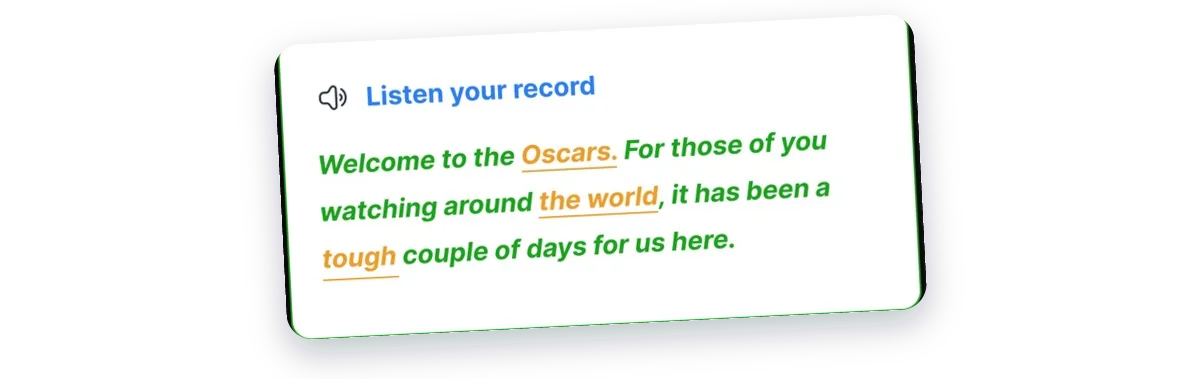
- Minutes 10–15: record yourself and compare against the original — the step that turns practice into progress.
The Mindset Shift: Stop Studying, Start Training
The reason so many diligent learners stay stuck is that they keep doing more of what already works — input — and avoid the uncomfortable thing that builds output. But your mouth is not going to learn to sprint by watching someone else run. Speaking is trained like a sport: reps, feedback, reps. That reframe is freeing, because it means you don't need a bigger vocabulary or more grammar to sound fluent — you need to train the words you already have until they come out automatically.

The Science of Shadowing: Common Questions
Is shadowing scientifically proven?
Shadowing has been studied for decades — first as a laboratory attention task, later as a training exercise for simultaneous interpreters, and more recently in language-teaching research. Studies consistently link regular shadowing to measurable gains in listening, pronunciation, and speech rate. It isn't a cure-all, but the mechanism — training perception and production together — is well grounded.
How long until shadowing rewires my brain?
There's no fixed number, but the brain proceduralizes skills through consistent, spaced repetition, not marathon sessions. Most learners notice smoother rhythm and faster recall within a few weeks of 10–15 focused minutes a day. The changes come from frequency, so a short daily habit beats an occasional long one.
Does shadowing work for adults?
Yes. The old idea that adults "can't" learn to speak naturally confuses harder with impossible. Adults keep the neural plasticity needed to build new auditory-motor patterns; they just need deliberate, repeated production to do it — which is exactly what shadowing provides.
The Bottom Line
You don't have a bad memory or the wrong kind of brain. You have a well-trained comprehension system and an under-trained production system, and no amount of extra reading will balance them. Shadowing works because it targets the exact mechanisms speaking depends on — coupling hearing to speaking, automating retrieval, strengthening the phonological loop, internalizing prosody, and chunking language into ready units.
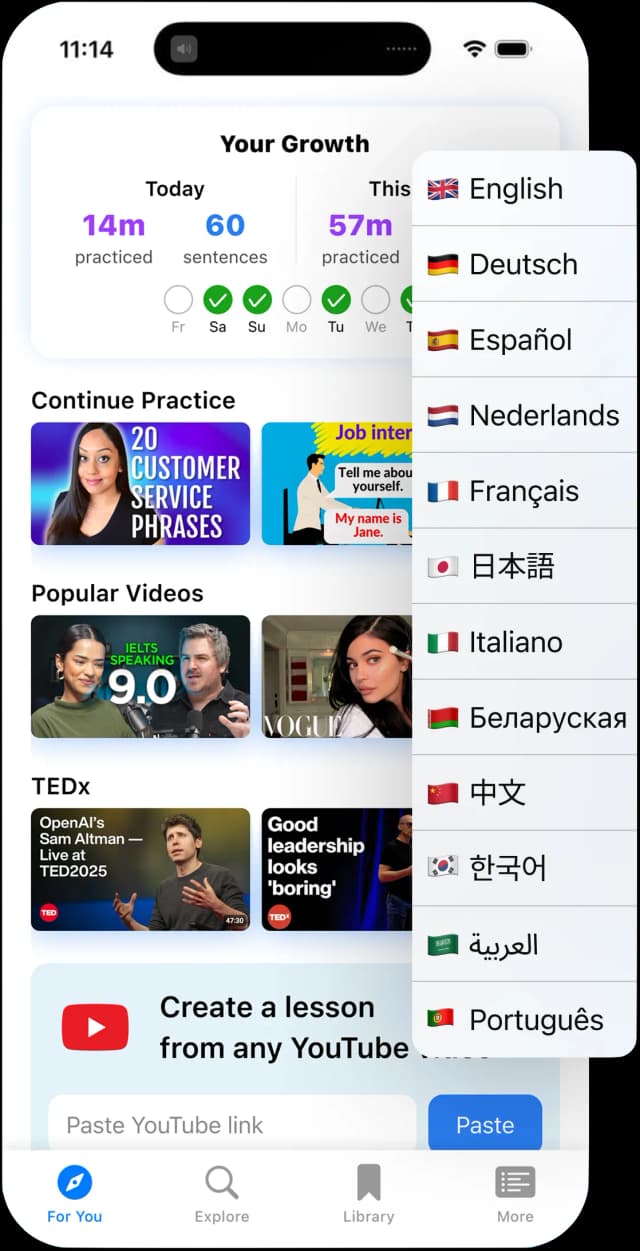
The fastest way to feel it is to do it with real audio and instant feedback. Speak Pro turns any YouTube video into a guided shadowing session, sentence by sentence, so the science runs on autopilot while you just practice.
Ready to finally speak instead of just study?
Turn any YouTube video into a guided shadowing session with instant AI feedback. Daily speaking practice becomes effortless.